Something exciting and worrying at the same time is happening and it’s all over my LinkedIn.
People who have never written a line of code are building and shipping real software products. Full apps, SaaS tools, marketplaces — described in plain language, built by AI. Replit, Lovable, Bolt, Cursor have made this real. GitHub Copilot has over 20 million users. The technical barrier that kept entrepreneurship in the hands of a minority is genuinely coming down.
This is opening the door for democratisation of innovation (defined as creating and applying something new, or meaningfully better, to solve meaningful problems and produce value at scale). And potentially for opening up the door widely to entrepreneurship itself. Worth pausing and reflecting. And asking: what if this is just the opening act, what next?
I’ve spent the past 15+ years building innovation and entrepreneurship capabilities inside large organisations and alongside innovative tech startups. The question I kept returning to though is how do you get these methods, habits and tools to everyone, everywhere? They’ve always been hard to scale. Vibe coding just proved that barriers that seemed permanent can fall fast. The question is which ones could fall next.
The build step is one part of a much bigger process in innovation
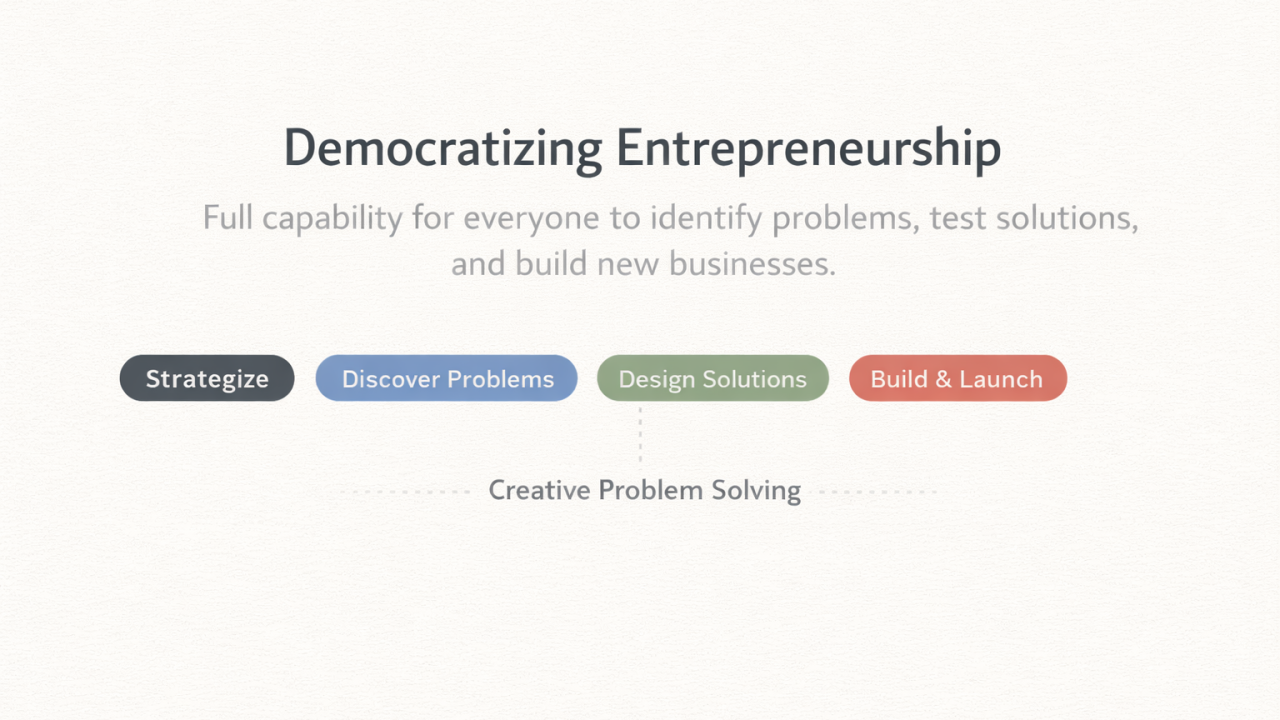
Innovation and entrepreneurship — whether you’re improving something at work, building a product, or launching a business — require working through a full process: identifying a problem that genuinely matters to people, understanding the people who have it, designing a creative solution, testing whether it creates real value, finding the right customers, and building something sustainable from it. Every part of this process is real work.
Vibe coding makes one part of it — building — significantly easier and more accessible. The rest of the process remains as demanding as it always was. And it is where most ventures succeed or fail. Most products and ventures build, launch and then discover: the problem wasn’t real enough, the solution didn’t fit, nobody was willing to pay. Poor product-market fit is consistently the most cited cause of startup failure (CB Insights). And beyond that — reaching the right customers, pricing correctly, building a sustainable model — these are where many otherwise promising ventures eventually stall.
Why most people never attempt the full process
The honest answer is that several things get in the way — and they tend to compound.
Most people don’t see themselves as innovators. The identity of entrepreneur or innovator has long been associated with a particular kind of person in a particular kind of place: the founder, the startup, Silicon Valley. For the nurse, the logistics manager, the mid-career professional with an idea — the thought of “doing innovation” can feel like it belongs to someone else. That identity gap is a real barrier, and it shapes what people even consider possible for themselves.
Fear is a significant part of the picture. McKinsey research found that fear of criticism, fear of uncertainty, and fear of career consequences are the three most common barriers to innovation in organisations — with fear of career impact being 3.6 times more prevalent in average-performing companies than leading ones. These fears are not irrational. In most professional environments, putting forward an untested idea, talking to customers before having answers, or running an experiment that might fail carries real social and professional risk.
There is no clear path through the process. Innovation and entrepreneurship involve a sequence of activities most people have never been taught: how to identify a problem worth pursuing, how to understand it through real conversations rather than assumptions, how to test a solution before committing to it, how to read whether something is working. Without a clear workflow, people skip the uncomfortable steps or default to what feels familiar — usually building something rather than first asking whether it is worth building.
The right networks are hard to access. Innovation rarely happens in isolation. Exchange of ideas, challenge from people with different perspectives, access to potential customers willing to engage early — these are what sharpen thinking and surface blind spots. Research consistently shows that diverse networks and honest external challenge are among the strongest drivers of successful innovation outcomes. These networks have always tended to cluster in the same places. Most people are simply not inside them.
These are not personal failings. They are patterns that emerge when the conditions for innovation are absent — and conditions can be changed.
What changes when the conditions exist
The creator economy offers an instructive parallel. When the tools for content creation became accessible, a new wave of creators didn’t automatically emerge. The tools were there, but creating well still required craft, feedback, and a sustainable practice loop. What changed things was infrastructure: communities and platforms that made create, share, learn, improve repeatable for ordinary people. Full-time digital creators in the US grew roughly sevenfold between 2020 and 2024. Tools enabled the possibility. The right conditions made it real.
Something similar seems possible for entrepreneurship and innovation now. Workflows and methods have matured, building what Tom and David Kelley at IDEO called “Creative Confidence” — when people work through small, real experiments using human-centred methods, they rebuild the belief that they can create things and shape outcomes. Design thinking habits replace feeling overwhelmed by a challenge with a sense of actionable progress — building the self-efficacy that one can build things that people want. That also addresses the identity barrier: people begin to see themselves as someone who can do this.
Access to the right people is also increasing with more networks and forums where people meet and exchange perspectives. And AI tools can reduce the cognitive load and help with decision making: AI can help map problem spaces, prepare for customer conversations, synthesise interview patterns, design validation experiments, and stress-test business models. The parts that require human judgement — talking to customers, listening without an agenda, deciding what the evidence is really telling you — remain the core of the work, and rightly so.
The opportunity
Only 21% of employees globally are engaged at work (Gallup). 49% of adults say fear of failure would stop them starting a business — a figure that has risen over five years, not fallen (GEM 2024/25). These numbers don’t describe a shortage of ambition or ideas. They describe a shortage of conditions.
The nurse who knows exactly why the patient discharge process keeps failing. The logistics manager who has watched the same inefficiency repeat for years. The person between jobs who has always had an idea and never a structured way to find out if it’s real. These are not edge cases. They are the majority — people who could work through the full innovation process if they had a clear workflow, a safe environment to try, and tools that made the demanding parts more manageable.
Vibe coding gave more people the ability to build. The larger opportunity — and the more important one — is making the full process of innovation accessible: the workflow that guides it, the environment that makes the difficult parts possible, and the tools that reduce the load where they can. If that happens, something real could shift. More people could get the confidence to build solutions that improve life. Entrepreneurship stops being a credential. Innovation stops being a department. The problems that have gone unsolved — not because no one could see them, but because the people closest to them had no workable path to act — start getting fixed.
That is much larger than the code. And something we can all get excited about.
Sources: CB Insights Startup Failure Report; GEM Global Entrepreneurship Monitor 2024/25; Gallup State of the Global Workplace 2024; McKinsey, Fear Factor: Overcoming Human Barriers to Innovation, 2022; Tom Kelley & David Kelley, Creative Confidence, 2013; Albert Bandura, Self-Efficacy: The Exercise of Control, 1997; Steve Blank, The Four Steps to the Epiphany; Eric Ries, The Lean Startup.