It’s the start of the year. Strategy plans are being refreshed.
Before another priority is locked in, there’s one question most leadership teams don’t pause to ask.
Most strategy conversations at this point in the year are thoughtful, disciplined, and well-intentioned. They bring clarity. They bring alignment. They create momentum. What they rarely do is pause to surface the mental model of the business everyone is already reasoning from — the underlying beliefs about how value is created, what really matters, and what kind of organisation “we are.”
That’s not a failure of leadership. It’s a natural consequence of success.
How success quietly hardens a mental model
Over time, every well-run organisation develops a shared logic about: how it makes money, who the “real” customer is, where advantage comes from, which risks are worth taking, what feels like a credible strategic move.
Because these beliefs are reinforced by results, they stop feeling like assumptions. They start feeling like unquestionable truths. What makes them particularly hard to surface is that they often feel objective. They’re backed by data. They’re supported by metrics. They’re validated by past performance. From the inside, they don’t feel like opinions at all — they feel like facts. That’s why even highly analytical leadership teams can miss them. The issue isn’t lack of rigour. It’s that rigour is being applied inside a frame that no longer gets questioned.
Getting very good at the wrong game
Once these unquestioned beliefs are in place, something subtle but consequential happens. The organisation gets exceptionally good at playing a particular game. Planning cycles optimise it. KPIs reinforce it. Talent, capital, and attention align around it. The risk is not that the organisation is playing the game badly. The risk is that the game itself may be changing — while the strategy conversation remains focused on getting better at the old one.
That’s why many established organisations feel busy, capable, and disciplined — yet struggle to articulate a convincing next chapter.
The “unquestionable truths” that quietly hold the game in place
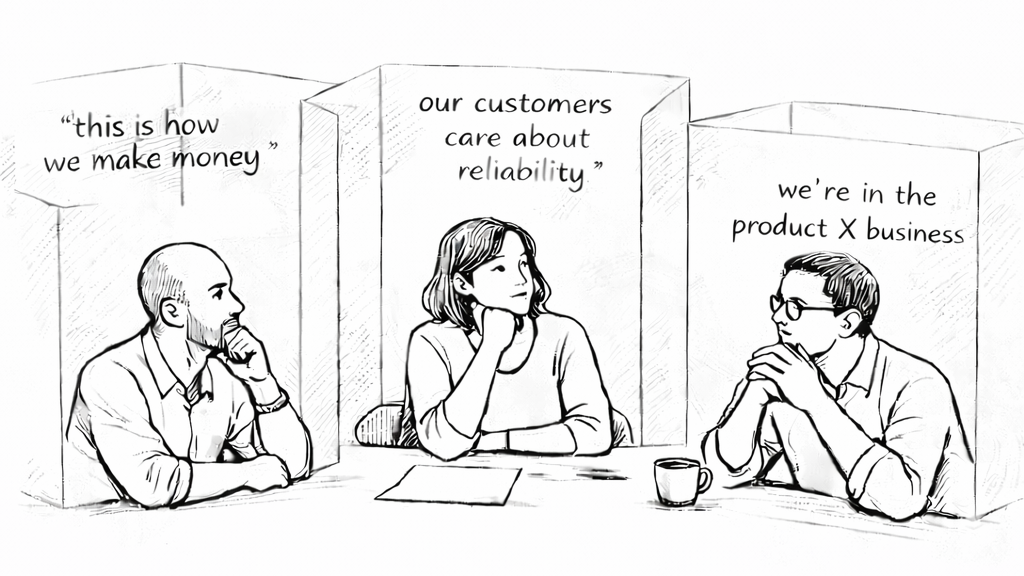
When leadership teams slow down and make their assumptions explicit, they often sound like this: “This is how we make money.” “Our customers care about reliability.” “We’re a product-led business.” “That’s not realistic for us.”
None of these statements are obviously wrong. In fact, most of them were earned. They reflect what has worked. But together, they form a status-quo bias — a mental box that quietly defines what feels realistic before alternatives are even examined.
These beliefs are also reinforced socially. Careers have been built on them. Investment cases depend on them. Status and credibility are often attached to defending them. Which means questioning them can feel risky — not intellectually, but organisationally.
Once these ideas harden into “how things are,” strategy conversations don’t deliberately exclude options. They filter them out automatically. From the inside, this feels like focus and discipline. From the outside, it can look like an organisation getting better and better at a game whose rules are quietly shifting.
What this looks like in real organisations
This pattern shows up repeatedly across industries.
Adobe had to confront the deeply held belief that software value is captured through perpetual licences. Surfacing that assumption — rather than debating features or pricing — was a necessary precursor to its shift to a subscription model.
Intel, at a critical moment, explicitly questioned the identity belief that it was fundamentally a memory company. Andy Grove’s question — “If we were replaced, what would the new CEO do?” — was a deliberate attempt to surface and loosen that mental model before decisions were locked in.
?rsted has been open about how its transition from fossil fuels to renewables required leaders to confront assumptions about competence, identity, and what kind of energy company they were allowed to be. The hardest work came before strategy choices — when beliefs were still implicit.
Maersk has acknowledged that seeing itself primarily as a shipping company constrained how leaders evaluated future value. Before any strategic shift, the critical move was surfacing the assumption that advantage came from ships and routes rather than from orchestrating end-to-end logistics.
In each case, the pivotal move wasn’t choosing a new strategy. It was making the old logic visible.
A practical way to start the right conversation
The most effective way to begin is in two deliberate steps.
Step one: reflect individually. Before the team meets, take a few minutes on your own and ask: What assumptions am I taking for granted about how this business creates value? Use the prompts below to surface where those assumptions might sit. Notice where answers feel settled or unquestionable. - How do we assume money is really made here? - What do we take for granted about what customers value most? - What do we believe about where our advantage comes from — and how durable it is? - Which strategic options feel “not realistic” almost immediately? - How clear are we about what kind of organisation we are — and what we are not?
At this stage, the point is not to challenge these beliefs — only to notice them.
Step two: open the conversation with the team. Rather than starting with options or priorities, bring one question into the room: What assumptions are currently shaping our thinking about this business — and which ones are we most reluctant to question?
That question often changes the tone of the discussion. Instead of optimising the current plan, the team begins to see the logic underneath it. Instead of defending positions, people start comparing assumptions.
So what should leaders actually open up for rethinking?
At the very start of a strategy cycle, the goal isn’t to reinvent everything. It’s to identify which parts of the existing model deserve to be reopened for scrutiny — before they silently constrain future choices.
In practice, this usually means revisiting four areas of the current logic:
1. The profit logic — Which revenue streams are treated as non-negotiable? Where do we assume “the economics only work this way”?
2. The customer definition — Which customers’ needs dominate decisions? Which voices are rarely heard?
3. The source of advantage — What do we believe makes us competitive — and where might we be overestimating durability?
4. Organisational identity — Which moves feel instinctively “not us” — and why?
Opening up these areas doesn’t mean abandoning the current model. It prevents it from becoming unexamined truth. At this stage, progress looks like better questions, not better answers.
Teams that do this work early tend to narrow their options later — and more deliberately. Not because they hesitate, but because they understand the game they’re playing before deciding whether it’s still the right one.