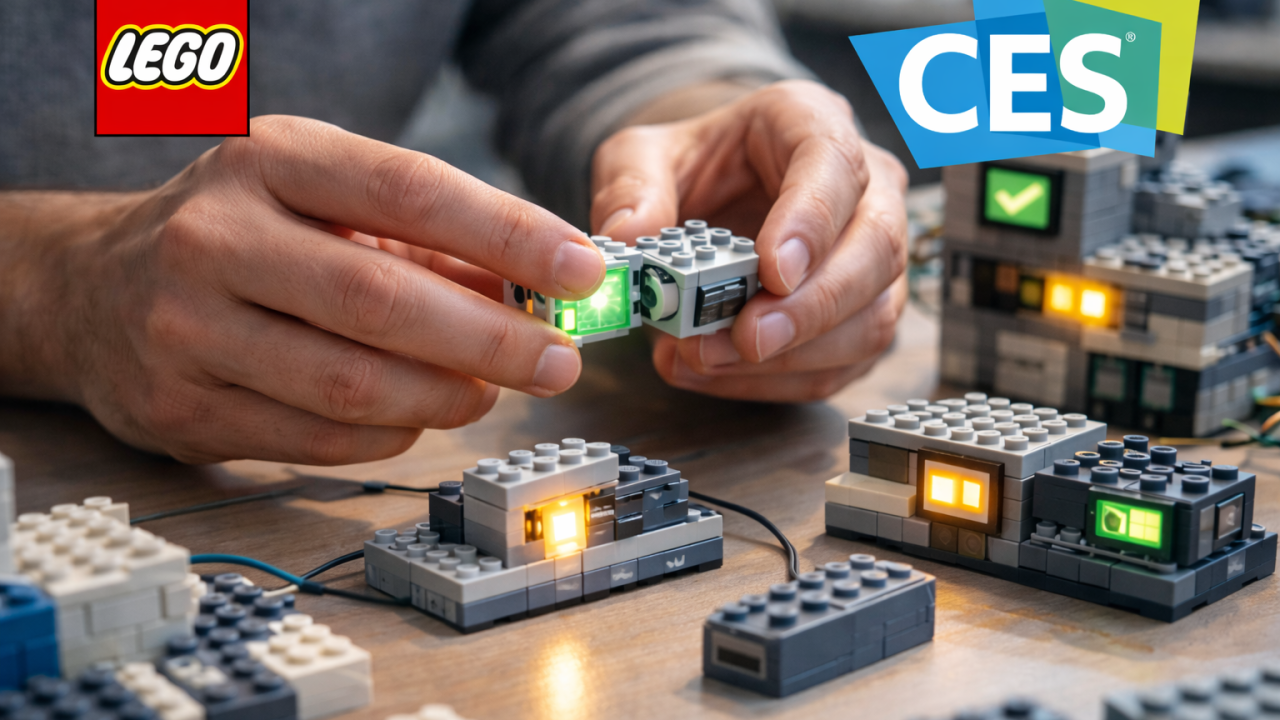
When LEGO announced Smart Play (“Smart Bricks”) and it was recognised at CES 2026, most of the attention went straight to the technology. Sensors in bricks. Light and sound. Physical-digital play. But if you stay with it for a moment, a different story emerges.
This isn’t really about adding technology to toys. It’s about how LEGO continues to innovate by doing the same fundamental job to be done better — helping people play — while the world around that job keeps changing.
Smart Play is best understood from the inside out. At a practical level, it adds a layer of responsiveness to physical LEGO builds. Certain elements can sense movement or connection and respond with light or sound. Children still build with their hands. They still invent the story. They still decide what the creation is and what it means.
Picture a child who builds a small vehicle and places a Smart element inside it. When they push it across the floor or tilt it, the vehicle lights up or makes a sound. There’s no screen leading the experience and nothing instructing them how to play. The response lives inside the thing they built. That detail matters. It shows where LEGO chose to intervene — and just as importantly, where it chose not to.
One useful way to make sense of this is through the Jobs to Be Done lens: people don’t buy products for their features; they “hire” them to make progress in a particular situation. Seen this way, LEGO’s job hasn’t changed much over time. It isn’t “to sell toys,” but to enable open-ended, physical, imaginative play — with all its emotional and social dimensions. Smart Play doesn’t introduce a new job. It’s an attempt to do the existing one better under today’s conditions.
This is where innovation often goes wrong for established organisations. Features get optimised, capabilities get added, but the connection to the underlying job weakens. The product improves on paper while the experience quietly drifts. LEGO has largely avoided that trap by being unusually clear about what it exists to do. Early on, it defined itself around play as a human experience, not around specific products. That framing has created continuity across decades. Materials changed. Mechanics evolved. Technology came and went. But every innovation still had to serve the same experience.
That clarity on its own wouldn’t be enough, though. What really sustains it is the system LEGO built around that purpose. Standardised connections and backward compatibility aren’t just clever design choices; they shape how innovation happens. New ideas can’t exist on their own terms. They have to connect to what already exists and make the whole experience better. Over time, this nudges innovation toward recombination rather than replacement — reusing, reconfiguring, and extending what’s already there. From the outside, this can look incremental. In reality, it’s how progress compounds without fragmenting the experience.
An often overlooked part of this story is the role of constraints. Limiting variation and forcing reuse doesn’t dampen creativity; it focuses it. Constraints keep the job to be done in view and prevent innovation from over-solving in ways that add complexity without adding meaning.
Imagination, in this context, isn’t treated as something abstract or accidental. LEGO repeatedly introduces collisions — new technologies, new materials, new communities — and uses them as prompts to ask counterfactual questions: What kind of play becomes possible if the job stays the same but the ingredients change? Smart Play fits that pattern. The technology is the prompt, not the point. The real work lies in deciding how that prompt can open up new kinds of play without taking authorship away from the player.
That mindset also explains why co-creation is so central to how LEGO innovates. Children, parents, and adult fans aren’t just end users; they’re part of how LEGO learns what play is becoming. Platforms like LEGO Ideas and long-standing fan communities are not side projects — they’re part of the feedback loop. Smart Play leaves room for that. Builders decide how — or whether — responsiveness matters. Some will ignore it. Some will hack it. Some will build around it entirely. Meaning emerges through use, not instruction.
LEGO’s own history shows what happens when coherence slips. In the late 1990s and early 2000s, creativity ran ahead of clarity. Too many initiatives pulled in different directions, and complexity overtook purpose. The recovery didn’t come from chasing something new; it came from reconnecting innovation to LEGO’s core job and being much clearer about what didn’t belong.
Step back from LEGO, and the broader lesson becomes clearer. Innovation with purpose starts by being explicit about the job you’re here to do. It protects the experience that makes that job meaningful. It builds systems and constraints that keep progress coherent. And it leaves space for people to co-create meaning through use, not configuration.
Sometimes, innovation isn’t about becoming something else. It’s about becoming more of yourself — doing your core job with greater care and relevance as conditions change. That, more than any individual launch or feature, is what LEGO continues to get right.